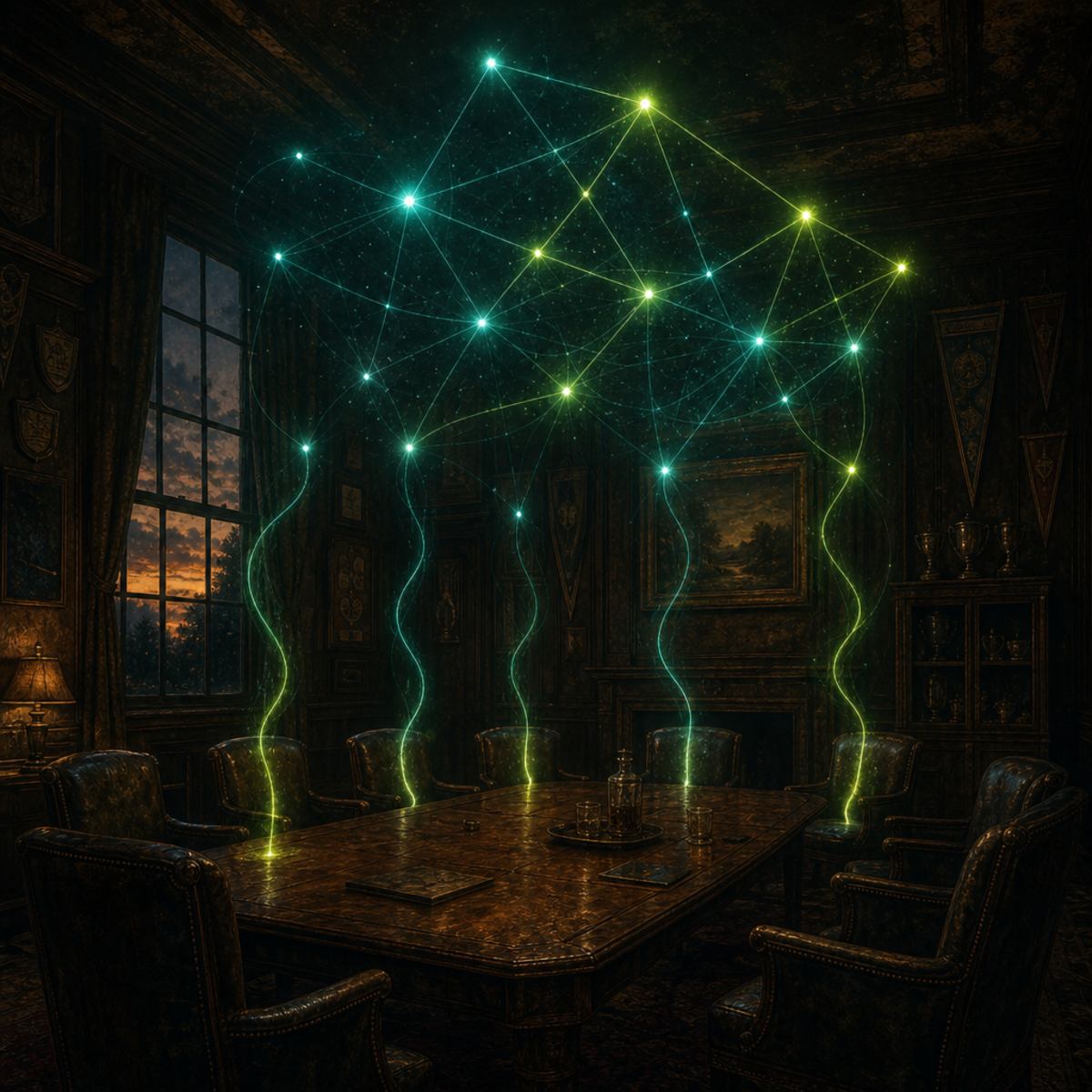
Picture the Renewal Meeting
Picture a Tuesday evening in a borrowed conference room. A Rotary club president, a good and tired human, is staring at a renewal spreadsheet. Twelve members not returning this year. Three passed away. The youngest person in the room is 58. The agenda: should we raise dues or cut the scholarship?
Around that same table sit a retired hospital administrator who ran three mergers, a builder who has priced every street in the city for 40 years, an accountant who has seen every way a family business dies, and a school principal who can read a teenager in ninety seconds.
The club is about to raise dues on the four people it should be paying.
That, in one room, is the missed opportunity of almost every community on earth. They are struggling for membership revenue while sitting on a golden asset nobody structured. Not their data. Not their brand. The accumulated good judgment of their members.
Why Are Membership Organisations Declining?
The numbers are the same story in every language. Rotary's US membership has fallen 29 percent since 2004, a loss of over 100,000 members. Australia is down 36 percent, Canada 34 percent, Great Britain and Ireland 33 percent, where the average member age reached 79 before new club formation pulled it down to 73. Chambers of Commerce are closing across the US. University alumni participation in giving sits at 35 percent overall and 13 percent among recent graduates.
The standard diagnosis blames busy lives, remote work, younger generations who "don't join things."
Wrong diagnosis. And the proof is in the same research.
Your Members Did Not Stop Being Generous
Here is the twist buried in the alumni data: 82 percent of alumni are philanthropic. They give money or time SOMEWHERE. 86 percent of lapsed donors actively give elsewhere. The generosity never left. It just left YOU.
Why? Because 74 percent of alumni say their institution does not know their personal interests at all. 68 percent say it does not know their career or life stage. Translation: the only thing the organisation ever learned about them was their billing address.
Now the stat that should be printed on every membership director's wall. Alumni who recently volunteered their time and expertise average $180,768 in lifetime giving. Those who never volunteered average $13,002.
Fourteen times more.
Read that with fresh eyes. The renewal letter has the causality backwards. Organisations treat expertise as the small ask and money as the big one. The data says the opposite: the human who is asked to CONTRIBUTE JUDGMENT becomes fourteen times more invested than the human who is asked to contribute cash.
You have been asking for the wrong thing, in the wrong order, for fifty years.
What Is the Golden Asset Communities Are Sitting On?
Every community is a judgment reservoir, and almost none of them have a structured way to collect what is in it.
A Rotary club is not a lunch club. It is several centuries of combined operator judgment sitting around one table: how to fire a friend, when to walk away from a deal, what a supplier's handshake is actually worth.
A Chamber of Commerce is not a mixer with a newsletter. It is the living map of how business actually gets done in a city: who delivers, which corners cannot be cut, what the unwritten rules are that no economic development brochure will ever print.
An alumni network is the largest unindexed expertise graph on earth. Fifty thousand people who share a bond, a vocabulary, and a willingness to take each other's calls, and the institution's grand plan for them is a magazine and a giving day.
None of it is written down. None of it is structured, searchable, or transferable. So the reservoir drains one retirement, one relocation, and one funeral at a time. The judgment does not get archived. It gets buried.
And this is the decade when letting it evaporate became unforgivable, because judgment just acquired a market price.
The Market Has Already Priced Your Asset
While communities were debating dues increases, an entire industry emerged that pays for one thing: structured human judgment.
AI labs now spend billions on human-in-the-loop work, paying doctors, lawyers, builders, and operators up to $100 an hour to teach models how experienced humans decide. I wrote about that market, and what happens when it is run badly, in the Mercor story. The detail that matters here: the scarcest input in the AI economy is exactly the thing your community's members carry in their heads.
Sit with the absurdity. A stranger on a platform gets $100 an hour for judgment. Your 40-year member gets a renewal invoice for hers.
Communities do not have a generosity problem or a relevance problem. They have an inventory problem. They own an asset the market has priced, and they have never counted it, structured it, or offered their members a way to contribute it.
What Does a Judgment Model Look Like?
The membership model sells access: to the room, the directory, the logo, the gala. Access is exactly what the internet made free, which is why the model is dying everywhere at once.
The judgment model does something different. It treats the community's accumulated wisdom as its core asset, and membership as the way you contribute to it and draw from it.
Three shifts, in plain language.
First, CAPTURE. Stop letting judgment evaporate in luncheon talks and hallway chats. Structure it: record the decision stories, the playbooks, the "here is what I would do" of your most experienced members, in a form that is searchable and lives beyond the person. A community that does this is building what the AI world calls a human context graph: a map of who knows what, in which situations, with which judgment.
Second, CONNECT. Match judgment to need inside the community. The data already told you this pays: the volunteer who mentors gives fourteen times more, stays longer, and brings others. Contribution is the retention strategy. Not the newsletter.
Third, VALUE. Once judgment is structured, it is an asset the community can steward: powering mentorship, informing local business, guiding the next generation, and yes, potentially earning in an economy that now pays for exactly this. The community stops being a line item members cut and becomes something members OWN a piece of.
Stop reading and do this now. Take your member count and multiply it by the average years of professional experience per member. A 100-person club averaging 30 years is 3,000 years of judgment. Write that number down. That is your unmined inventory, and until today it has appeared nowhere in your annual report.
Frequently Asked Questions
Why are membership organisations like Rotary and Chambers of Commerce losing members?
Membership decline is structural, not generational apathy. Rotary's US membership is down 29 percent since 2004, with similar declines across Australia, Canada, and Britain. The deeper cause is a value proposition built on access (rooms, directories, events) that the internet made free, while the organisations never learned what their members know, care about, or could contribute.
Did alumni and members actually become less generous?
No. 82 percent of alumni give money or time somewhere, and 86 percent of lapsed donors actively give elsewhere. Generosity migrated to places that ask for more than money. Alumni who volunteer expertise give 14 times more over a lifetime than those who don't, which shows contribution of judgment drives financial generosity, not the reverse.
What is the judgment model for communities?
A judgment model treats the accumulated expertise of members as the community's core asset. Instead of selling access through dues, the organisation captures member judgment in structured, searchable form, connects it to members who need it, and stewards it as a compounding asset the community owns together, one that survives any individual member's departure.
How can a community start capturing member judgment?
Start small and structural: record decision stories and playbooks from your most experienced members, index who knows what and in which situations, and build contribution of expertise into membership itself rather than treating it as an occasional volunteer ask. The exercise that reveals the stakes: member count multiplied by average years of experience equals the years of judgment currently sitting uncollected.
Your Move
The renewal letter asks your members for the least valuable thing they own.
Ask for their judgment first. Structure it. Steward it. The money, the data shows, follows the wisdom, fourteen times over.
Go do the inventory exercise tonight. Then come back and tell me your number, because I promise no dues increase on earth competes with 3,000 years of judgment.
If curious, tell me what is true.
Sallyann Della Casa, Founder and CEO, GLEAC / Lovely Humans